
When you’re depressed, telling yourself to “just be happy” usually doesn’t work. Depression isn’t simply a bad mood, and happiness isn’t a switch you can flip. Depression can affect your energy, motivation, sleep, concentration, appetite, relationships, and even your ability to enjoy things that normally matter to you.
So, how do you make yourself happy when you’re depressed?
A more realistic goal is to stop trying to manufacture happiness and start creating small opportunities to feel a little better. Get out of bed. Take a shower. Walk for ten minutes. Text someone you trust. Eat something nourishing. Schedule a counseling appointment. Do one activity you used to enjoy, even if you don’t particularly feel like doing it.
These actions may sound almost too simple, but several of them overlap with strategies recommended by mental health professionals. The National Institute of Mental Health (NIMH) notes that physical activity, regular sleep, healthy meals, social connection, and returning to enjoyable activities can support recovery alongside appropriate treatment.
Most importantly, don’t judge your progress by whether you feel “happy” today. Feeling 5% better is still movement.
First, Understand What Depression Does to Happiness
Depression can include persistent sadness, but it can also feel like emptiness, exhaustion, irritability, hopelessness, or emotional numbness.
One particularly frustrating symptom is anhedonia—a reduced ability to experience interest or pleasure.
You may remember loving movies, cooking, hiking, gaming, music, gardening, or spending time with friends and wonder:
“Why doesn’t any of this make me happy anymore?”
That doesn’t necessarily mean you’ve permanently changed or that those things no longer matter to you. It can be part of depression.
According to the World Health Organization’s depression guidance, depression can involve a loss of pleasure or interest for extended periods, and effective treatments are available.
This distinction matters because it changes the question from:
“Why can’t I make myself happy?”
to:
“What small actions can support my recovery today?”
That’s a much more useful question.
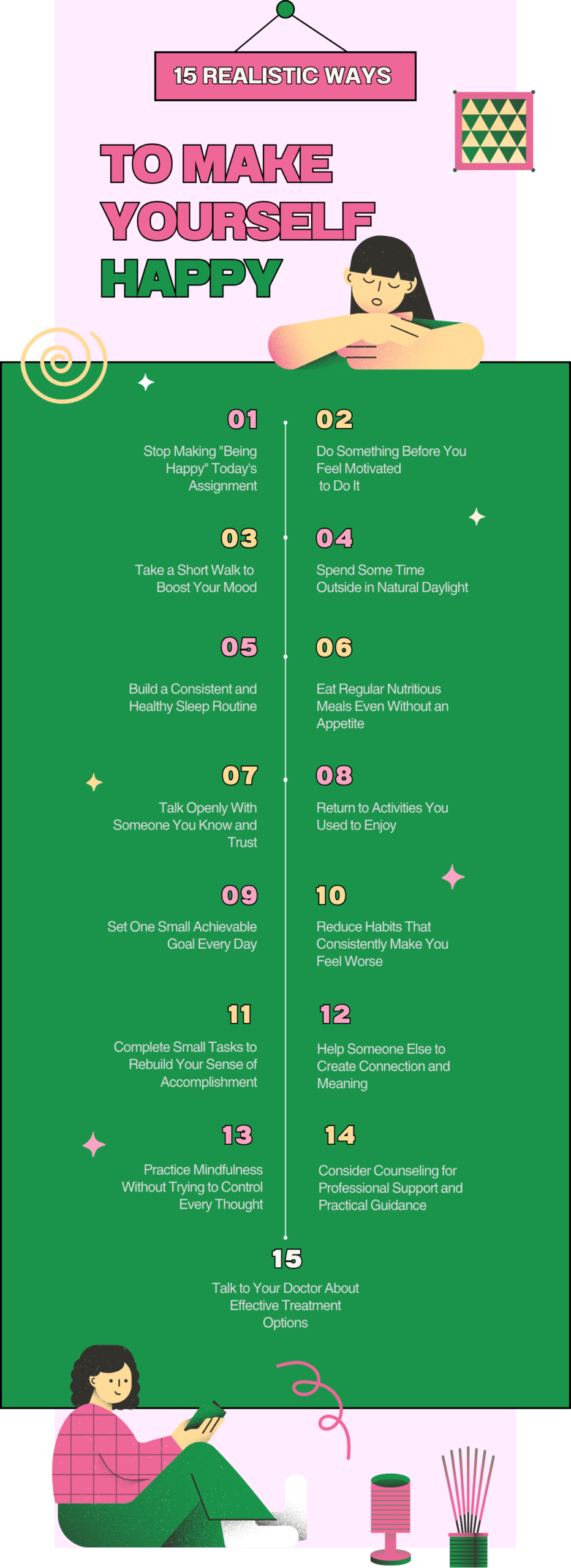
1. Stop Making “Being Happy” Today’s Assignment
This sounds strange in an article about becoming happier, but it can be incredibly helpful.
If you’re depressed, demanding happiness from yourself can create another opportunity to feel like you’ve failed.
Instead, lower the target.
Try asking:
- What would make today slightly easier?
- What could make me feel 5% better?
- What is one thing I can do for myself in the next ten minutes?
- What would I suggest to a friend who felt exactly like this?
Maybe happiness isn’t available this morning.
But a warm shower might be.
A decent breakfast might be.
Ten minutes outside might be.
A conversation might be.
Recovery can be built from these seemingly unremarkable moments.
2. Do Something Before You Feel Motivated to Do It
Depression creates a nasty paradox.
You don’t do things because you don’t feel motivated. But doing fewer things can leave you with even fewer opportunities for pleasure, accomplishment, connection, and confidence.
One evidence-based approach designed to interrupt this pattern is behavioral activation.
Rather than waiting until you feel motivated, you intentionally schedule manageable activities that could provide pleasure, connection, accomplishment, or meaning. The World Health Organization lists behavioral activation among effective psychological treatments for depression.
Start ridiculously small.
Instead of:
“I need to clean my apartment.”
Try:
“I’ll put five things away.”
Instead of:
“I should exercise for an hour.”
Try:
“I’ll walk around the block.”
Instead of:
“I need to get my life together.”
Try:
“I’ll make my bed.”
Action doesn’t always follow motivation.
Sometimes motivation follows action.
3. Take a Short Walk
Walking isn’t a magical cure for depression, but physical activity can be a useful part of treatment and self-care.
NIMH suggests trying to get physical activity and notes that even walking can help improve mood.
You don’t need a gym membership, expensive equipment, or a complicated fitness program.
Try:
- walking for 10–20 minutes
- walking while listening to a podcast
- taking your dog outside
- walking to get coffee
- stretching at home
- gardening
- cycling
- swimming
- dancing to a few songs
If you’re currently very inactive, don’t turn exercise into another source of guilt.
Five minutes counts.
Ten minutes counts.
The goal is movement, not athletic achievement.
4. Get Outside and Experience Daylight
When depression encourages you to stay under the covers all day, stepping outside can feel surprisingly difficult.
Try anyway, even briefly.
Sit on your porch. Walk to the mailbox. Drink your morning coffee outside. Walk through a nearby park.
Daylight exposure also helps regulate your body’s circadian rhythm, which influences sleep and wakefulness.
If your depression follows a seasonal pattern—particularly worsening during fall and winter—talk with a healthcare professional. Seasonal affective disorder (SAD) is a recognized form of depression, and treatments can include psychotherapy, medication, and light therapy.
5. Rebuild Your Sleep Routine
Depression and sleep have an unpleasant relationship.
You might sleep for 12 hours and still feel exhausted.
Or you may desperately want to sleep but find yourself awake at 3 a.m.
Either way, maintaining a reasonably consistent sleep schedule can help.
Try keeping your bedtime and wake-up time relatively stable, including on weekends. Create a simple wind-down routine and reduce late-night behaviors that keep you awake unnecessarily.
NIMH specifically recommends maintaining regular bedtime and wake-up times as part of depression self-care.
Don’t expect one perfect night’s sleep to transform your mood. Think in terms of establishing a rhythm over time.
6. Eat Something, Even When You Don’t Feel Like It
Depression can disrupt appetite in opposite directions.
Some people barely eat.
Others eat much more than usual.
Rather than chasing a “perfect depression diet,” focus first on regular nourishment.
If preparing food feels overwhelming, simplify it.
A sandwich, eggs and toast, yogurt and fruit, soup, oatmeal, frozen vegetables, or a simple prepared meal is better than skipping food because you couldn’t cook something impressive.
Keep easy options around for difficult days.
Your goal isn’t culinary excellence.
It’s taking care of your body while your mind is having a hard time.
7. Talk to One Person You Trust
Depression often whispers:
“Don’t bother them.”
“Nobody wants to hear this.”
“Stay home.”
Isolation can then deepen the problem.
You don’t need to organize a party or suddenly become highly social. Start with one safe person.
Send a simple message:
“I’ve been having a rough week. Want to grab coffee?”
You don’t even have to discuss depression if you aren’t ready. Sometimes sitting beside someone, watching a movie, taking a walk, or eating dinner together is enough to interrupt isolation.
WHO recommends staying connected with friends and family and talking with someone you trust as part of depression self-care.
8. Bring Back Something You Used to Enjoy
Here’s another frustrating feature of depression: you may not want to do the things you normally enjoy.
Don’t wait for the desire to return completely.
Experiment.
Ask yourself:
“Before I became depressed, what made me feel like myself?”
Maybe it was:
- cooking
- playing guitar
- fishing
- reading
- drawing
- watching comedy
- woodworking
- gardening
- photography
- baking
- hiking
- playing basketball
- spending time with your pet
Choose one and shrink it.
You don’t need to read a novel. Read five pages.
You don’t need to cook an elaborate dinner. Make your favorite breakfast.
You don’t need to hike six miles. Walk through the park for twenty minutes.
Think of it as reopening a door rather than forcing yourself to walk all the way through it.
9. Give Yourself One Small Mission Every Day
Depression can make days blur together.
Creating one achievable daily objective can restore a little structure and accomplishment.
For example:
Today’s mission:
Take a shower.
Tomorrow’s mission:
Walk for 15 minutes.
Wednesday’s mission:
Call Mom.
Thursday’s mission:
Schedule a counseling appointment.
Friday’s mission:
Cook dinner instead of ordering food.
Keep the mission small enough that completing it is realistic.
This isn’t about productivity.
It’s about rebuilding momentum.
10. Reduce the Things That Reliably Make You Feel Worse
Not everything that temporarily distracts you actually helps.
Alcohol is a good example. Someone might drink because it briefly numbs sadness or anxiety, but relying on alcohol or drugs can complicate depression and recovery. NIMH recommends avoiding alcohol, nicotine, drugs, and medications that aren’t prescribed to you when dealing with depression.
Also pay attention to your digital habits.
If you spend two hours scrolling through other people’s vacations, relationships, careers, bodies, houses, and achievements and consistently feel worse afterward, that’s useful information.
You don’t necessarily need to delete every social media account.
Try changing the environment instead.
Mute accounts that trigger unhealthy comparison. Stop doomscrolling in bed. Put your phone across the room while you’re doing something else.
Protecting your attention can be an underrated form of self-care.
11. Do Something That Creates a Sense of Accomplishment
Pleasure isn’t the only emotion worth pursuing.
Depression often damages confidence and creates the feeling that you’re incapable of doing anything.
Small accomplishments push back against that story.
Wash the dishes.
Reply to one email.
Change your sheets.
Fix something that’s been broken.
Finish a small work assignment.
Organize one drawer.
Pay a bill you’ve been avoiding.
You probably won’t finish and shout, “I’m cured!”
That’s not the point.
You may instead think:
“Okay. I actually did something today.”
That matters.
12. Help Someone Else
When you have enough emotional capacity, helping another person can provide connection and meaning.
That doesn’t mean ignoring your own needs or becoming responsible for everybody else’s problems.
Keep it small.
Call an elderly relative.
Help your neighbor carry groceries.
Volunteer at an animal shelter.
Cook dinner for someone.
Send a thoughtful message.
Donate unused clothes.
Helping someone else can temporarily shift your attention away from the endless internal conversation depression sometimes creates.
Meaning and happiness aren’t identical, but they often overlap.
13. Try Mindfulness Without Expecting Your Mind to Become Empty
Meditation gets marketed as though successful meditation means sitting peacefully while absolutely nothing enters your mind.
That’s unrealistic.
Mindfulness is more about noticing what’s happening without automatically getting dragged into every thought.
Suppose your brain says:
“I’m a failure.”
Instead of immediately accepting it as a fact, try noticing:
“I’m having the thought that I’m a failure.”
That tiny change creates distance between you and the thought.
You can experiment with:
- slow breathing
- guided meditation
- body scans
- progressive muscle relaxation
- mindful walking
- five-minute meditation sessions
If sitting quietly makes you more distressed, don’t force it. Mindfulness is one tool, not a requirement for recovery.
14. Consider Counseling or Psychotherapy
You don’t have to wait until depression becomes unbearable before reaching out to a counselor.
Counseling is one of the most practical steps you can take when depression starts interfering with everyday life.
Psychotherapy isn’t simply sitting in a room and talking about everything that went wrong during childhood. Depending on the approach, therapy can be surprisingly practical.
For example, Cognitive Behavioral Therapy (CBT) can help you identify and challenge unhelpful patterns of thinking and behavior.
Interpersonal Therapy (IPT) focuses more closely on relationships, communication, grief, conflicts, and life transitions that may affect depression.
Behavioral activation helps you gradually rebuild activities that provide pleasure, achievement, social connection, or meaning.
NIMH identifies CBT and interpersonal therapy among evidence-based treatments for depression and notes that psychotherapy may be provided in person or through telehealth.
When Should You Consider Seeing a Counselor?
Consider reaching out when sadness, emptiness, hopelessness, low motivation, sleep changes, loss of interest, or other symptoms persist—especially when they begin affecting work, school, relationships, self-care, or daily functioning.
You don’t need to know exactly what’s wrong before scheduling an appointment.
You can literally begin with:
“I haven’t felt like myself lately, and I don’t know what to do.”
That’s enough to start the conversation.
15. Talk to a Doctor About Treatment Options
Self-help has limits.
If you’re experiencing significant or persistent depression, speak with a healthcare professional rather than trying to handle everything alone.
A clinician can also evaluate whether another health issue or medication could be contributing to symptoms.
Treatment for depression commonly includes psychotherapy, medication, or a combination of both. For some people who don’t respond adequately to standard approaches, other treatments may be considered.
Finding the right treatment isn’t always immediate.
A therapy style that works wonderfully for one person may not suit another. Medications can also affect people differently.
Needing adjustments doesn’t mean treatment has failed.
It means treatment is being adjusted.
What Famous People With Depression Can Teach Us
It’s tempting to look at successful people and assume they’ve discovered some secret route around sadness.
They haven’t.
Some highly accomplished people have publicly described serious mental health struggles. Their experiences aren’t proof that a particular treatment will work for everyone, but they do challenge the idea that depression means your life can’t improve.
Michael Phelps
Michael Phelps became the most decorated Olympian in history, yet his extraordinary athletic success didn’t protect him from depression.
He has spoken openly about serious mental health struggles and the importance of becoming willing to talk about them. The American Psychological Association notes that Phelps and fellow Olympian Simone Biles have publicly discussed how therapy supported their well-being and performance.
The useful lesson isn’t, “Become an Olympic champion and you’ll be happy.”
It’s almost the opposite.
Achievement alone isn’t necessarily treatment for emotional pain.
Asking for help can matter even when everything appears successful from the outside.
Kristen Bell
Actress Kristen Bell has also spoken publicly about living with anxiety and depression.
Her message through the Child Mind Institute has highlighted something particularly relevant today: don’t compare your internal struggles with the polished version of somebody else’s life you see online.
That’s worth remembering when depression tells you everyone else has life figured out.
They don’t.
Lady Gaga
Lady Gaga has discussed significant mental health struggles related to trauma and has spoken publicly about receiving professional treatment, including talk therapy and DBT, as well as medical care.
Again, her experience shouldn’t be treated as a treatment recommendation for anyone else.
What it illustrates is simpler: even someone with enormous professional success, money, recognition, and creative opportunities can need substantial mental health support.
Depression isn’t defeated by becoming sufficiently successful.
Sometimes getting better begins with getting appropriate help.
Books That May Help You Understand Depression Better
Books can’t replace professional treatment, but the right book can help you understand what’s happening and give you practical exercises to work through.
A few worth exploring include:
Feeling Good by David D. Burns, MD
A classic self-help book based on cognitive behavioral therapy principles. It focuses heavily on recognizing distorted thinking patterns and developing more realistic responses to them.
The Upward Spiral by Alex Korb, PhD
This book explores depression through a neuroscience lens while offering practical ideas around exercise, sleep, decision-making, social connection, gratitude, and habits.
The Happiness Trap by Russ Harris
Based on Acceptance and Commitment Therapy (ACT), this book takes an interesting approach: instead of desperately trying to eliminate unpleasant thoughts and feelings, you learn to change your relationship with them while moving toward a meaningful life.
A book should be a supporting tool, not another assignment you feel guilty about failing to finish.
Read five pages if five pages is what you can manage.
What About Motivational Videos?
A good video can sometimes give you enough energy to get through a difficult afternoon.
Just don’t confuse inspiration with treatment.
If you enjoy watching mental health content, prioritize material from licensed psychologists, psychiatrists, therapists, universities, hospitals, or established health organizations rather than influencers promising to “cure depression naturally.”
You might also find personal mental health stories useful. Interviews with athletes such as Michael Phelps can be particularly powerful because they show that someone can struggle profoundly despite appearing exceptionally successful.
Use motivational content as a spark.
Then turn that spark into an action.
Watch the video—and then take the walk.
Create a “Minimum Viable Day”
On particularly difficult days, forget the giant self-improvement checklist.
Create what I like to call a minimum viable day.
Your list might be:
- Get out of bed.
- Brush your teeth.
- Take prescribed medication.
- Eat something.
- Drink water.
- Go outside for ten minutes.
- Talk to one human being.
- Do one necessary task.
- Do one potentially enjoyable thing.
- Go to bed at a reasonable time.
That’s enough.
When you’re doing better, you can do more.
When you’re struggling, returning to the basics is not laziness. It’s strategy.
What Usually Doesn’t Work
There are also some traps worth avoiding.
Waiting to Feel Motivated
If you wait until you genuinely want to exercise, socialize, cook, or leave the house, you may wait a very long time.
Try small actions first and allow feelings to catch up later.
Forcing Positive Thinking
You don’t need to stare into a mirror and announce:
“MY LIFE IS AMAZING!”
when you don’t believe it.
Aim for realistic thinking, not artificial positivity.
Instead of:
“Everything is terrible and nothing will ever change.”
Try:
“Things are extremely difficult right now, but I don’t know how I’ll feel three months from now.”
That’s believable.
Comparing Your Recovery With Someone Else’s
One person may feel significantly better after several weeks of therapy.
Another may need longer-term treatment.
Someone else may need medication plus therapy.
Recovery isn’t a race.
Trying to Fix Your Entire Life at Once
Depression already reduces energy and motivation.
Creating a 37-item morning routine isn’t necessarily going to help.
Choose one or two changes.
Make them manageable.
Then build from there.
A Simple 7-Day “Feel a Little Better” Plan
If you’re unsure where to begin, try this.
Day 1: Take a 10-minute walk outside.
Day 2: Call or meet someone you trust.
Day 3: Do one activity you previously enjoyed for 20 minutes.
Day 4: Clean or organize one small area of your home.
Day 5: Research counselors or therapists and contact one.
Day 6: Spend an hour away from social media and do something offline.
Day 7: Write down what helped, what didn’t, and what you’d like to continue next week.
Notice what this plan doesn’t require.
You don’t need to wake up at 5 a.m.
You don’t need to run five miles.
You don’t need to meditate for an hour.
You don’t need to become a different person.
You’re simply experimenting with ways to make tomorrow a little easier than today.
Frequently Asked Questions
Can you actually make yourself happy when you’re depressed?
You usually can’t command yourself to become happy instantly. However, you can take actions that support recovery and increase opportunities for pleasure, connection, accomplishment, and meaning. Treatment can also significantly reduce depressive symptoms.
Why doesn’t anything make me happy anymore?
Loss of interest or pleasure can be a symptom of depression. It’s sometimes called anhedonia. If it persists or significantly interferes with your life, consider speaking with a mental health professional.
Should I force myself to socialize when depressed?
You don’t need to force yourself into exhausting social situations. Instead, aim for manageable connection—a phone call, coffee with a friend, dinner with family, a walk with someone you trust, or another low-pressure interaction.
Does exercise cure depression?
No. Exercise shouldn’t be presented as a guaranteed cure. Physical activity can be a helpful component of managing depression, but moderate or severe depression may require psychotherapy, medication, or other professional treatment.
When should I seek professional help?
If symptoms are severe, persistent, worsening, or interfering significantly with daily functioning, talk with a healthcare professional. NIMH advises seeking professional help for severe symptoms lasting two weeks or more, although you never need to wait exactly two weeks to ask for help.
Final Thoughts: Don’t Chase Happiness—Build Conditions Where It Can Return
If you’re depressed, your job isn’t to wake up tomorrow and magically become happy.
Make the goal smaller.
Get out of bed.
Open the curtains.
Eat breakfast.
Walk around the block.
Answer your friend’s text.
Do something you once enjoyed.
Make the counseling appointment you’ve been postponing.
Then do another small thing tomorrow.
Depression can make the future look permanently dark. But the way you feel during a depressive episode isn’t necessarily an accurate forecast of the rest of your life. Effective treatments exist, and improvement is possible.
And remember what stories from people such as Michael Phelps, Kristen Bell, and Lady Gaga actually demonstrate: you don’t have to become happy before asking for help. Getting help may be part of how happiness gradually finds its way back.
Important: If depression includes thoughts of suicide, self-harm, or feeling that you may not be able to keep yourself safe, seek immediate professional or emergency help rather than relying on self-help strategies alone.