
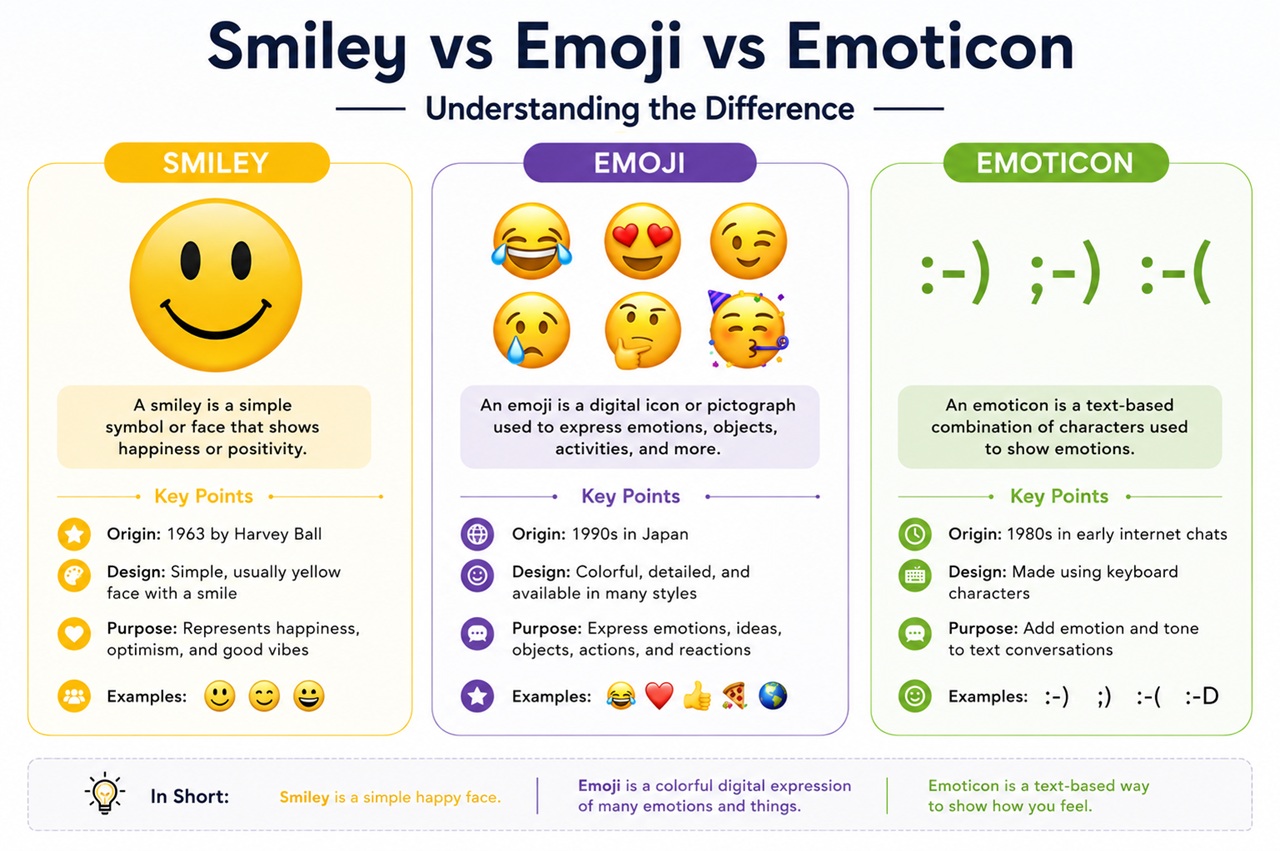
Quick answer, before we go deep: an emoticon is a face you type out of keyboard characters, like :-). An emoji is an actual little picture, like 🙂. And a smiley is the specific happy-face symbol itself — which can show up as either an emoticon or an emoji.
In other words, they’re not three names for the same thing. They’re three different ideas that overlap, and the most common mistake — including in a lot of articles on this exact topic — is treating “emoji” and “emoticon” as synonyms. They’re not, and the reason why is honestly a little surprising.
Here’s the cheat sheet, then we’ll unpack each one.
| Term | What it is | Made of | Examples | Born |
|---|---|---|---|---|
| Emoticon | A face typed from keyboard characters | Punctuation, letters, numbers | 🙂 😉 🙁 XD ¯\(ツ)/¯ | ~1982 |
| Emoji | A standardized picture character | Actual images encoded in Unicode | 🙂 🎉 ❤️ 🐈 | 1999 |
| Smiley | The smiling-face symbol itself | A graphic — or a happy emoticon/emoji | 🙂, :), the yellow face | 1963 |
What Is an Emoticon?
An emoticon is a face you build out of stuff that’s already on your keyboard — colons, parentheses, hyphens, letters. The word itself is a portmanteau of “emotion” and “icon,” as Britannica notes. Hold onto that, because it’ll matter when we get to emoji.
The classic Western emoticon is read sideways. Tilt your head left and 🙂 becomes a grinning face, 🙁 becomes a frown, 😉 becomes a wink, and XD becomes someone laughing with their eyes squeezed shut.
The credit for kicking this off usually goes to computer scientist Scott Fahlman, who in 1982 proposed using 🙂 and 🙁 on an early online message board to mark which posts were jokes. Three keystrokes, and the emoticon was born.
Meanwhile, over in Japan, people independently developed their own style around the same time, called kaomoji (literally “face characters”). These read upright instead of sideways and lean on the eyes for expression: (^^) for happy, (T_T) for crying, and the famous shrug ¯\(ツ)_/¯. Same basic idea, different visual grammar.
The defining trait of every emoticon, Western or Japanese, is this: it’s made of typed text. No image file involved. You’re drawing a face out of punctuation.
What Is an Emoji?
An emoji is not typed — it’s a tiny picture. 🙂 is a single image, the same way a photo is, even if you summoned it by tapping a keyboard. Thumbs up 👍, a birthday cake 🎂, a cat 🐈, a red heart ❤️ — all emoji, and notice that most of them have nothing to do with emotions at all.
Now for the surprise that trips almost everyone up. “Emoji” sounds like it comes from “emotion,” but it doesn’t. The word is Japanese: e (絵) meaning “picture” and moji (文字) meaning “character.” Emoji literally means “picture character.” The resemblance to “emotion” is a complete coincidence — a linguistic accident that probably helped the word catch on in English, as Dictionary.com points out.
Emoji were created in 1999 by Japanese designer Shigetaka Kurita for a mobile internet service, starting with a set of 176 tiny 12-by-12-pixel images. For years they stayed mostly in Japan. Then the Unicode Consortium — the body that standardizes text across all devices — adopted emoji in 2010, which is why the same 🙂 you send from an iPhone shows up as a (roughly) matching face on an Android.
That standardization is the key technical difference. An emoji is an official character with a code, recognized worldwide, that renders as a picture. An emoticon is just characters you arranged yourself.
What Is a Smiley?
Here’s where people get loosest with their language, so let’s be precise.
A smiley is the smiling face itself — the round, cheerful happy face. It’s a subject, not a format. The original is the bright yellow smiley face created by American artist Harvey Ball in 1963 for an insurance company’s morale campaign: a yellow circle, two dots, and a curved smile.
Because “smiley” refers to the image rather than the technology, the same smiley can appear in multiple forms. The emoticon 🙂 is a smiley. The emoji 🙂 is a smiley. The yellow button on a T-shirt is a smiley. They’re all the happy face wearing different outfits.
One more wrinkle: “Smiley” is also a registered brand. A French company, The Smiley Company, trademarked the name and the iconic face and turned it into a global licensing business. So depending on context, “Smiley” might mean the general happy-face concept or a specific brand.
In everyday American usage, though, when someone says “send me a smiley,” they just mean the happy face — in whatever form your app produces.
So How Do They Actually Relate?
If the overlap is making your head spin, here’s the clean mental model that sorts it out.
Think of emoticon as a technique — making faces out of typed characters. Think of emoji as a system — a standardized library of picture characters. And think of smiley as a subject — one particular thing, the happy face, that can be expressed in either format.
So a smiley can be an emoticon, like :), or an emoji, like 🙂. But an emoji doesn’t have to be a smiley — 🚗 and 🌮 are emoji and nobody’s smiling. And an emoticon doesn’t have to be a smiley either — 🙁 is an emoticon and it’s frowning.
The cleanest way to say it: emoticon and emoji are two different ways to make symbols, while smiley is one of the things you can make.
Why People Mix Them Up
Three reasons, and they all make sense once you see them.
First, the “emotion” false friend. Because “emoji” sounds like it’s built from “emotion,” people assume emoji and emoticons are the same family. They’re not even etymological cousins.
Second, emoji basically replaced emoticons. Once phones could render real picture emoji, most people stopped typing 🙂 and started tapping 🙂. The old technique faded, the word “emoticon” faded with it, and “emoji” became the catchall — even when someone technically means an emoticon.
Third, the words genuinely do overlap. A happy face can be all three things at once depending on how you look at it, so it’s no wonder casual speech blurs the lines.
For everyday conversation, mixing them up is harmless. If you call 🙂 an emoji, the world will keep turning. But if you write about communication, design, or tech — or you just like being right — the distinctions are real and worth keeping straight.
Which Word Should You Use?
Here’s my practical rule of thumb.
If it’s a picture you tapped from your phone’s keyboard, it’s an emoji. That covers the vast majority of what people send today.
If it’s a face you built from punctuation — :), ;), or a wild ¯\(ツ)/¯ — it’s an emoticon.
And if you’re specifically talking about the happy face as a concept or a symbol, regardless of format, smiley is the right word.
The Bottom Line
They’re not interchangeable, even though they’re often used that way. An emoticon is typed from keyboard characters and read like a tiny puzzle. An emoji is a standardized picture with its own code, and despite the sound of the word, it has nothing to do with “emotion.” A smiley is the happy face itself — old enough to predate both, and flexible enough to live inside either.
So the next time someone sends you a 🙂, you’ll know exactly what to call it: an emoji that happens to be a smiley. And if they typed 🙂 instead, that’s an emoticon that happens to be a smiley. Same grin, three different words, and now you know which is which. 🙂