
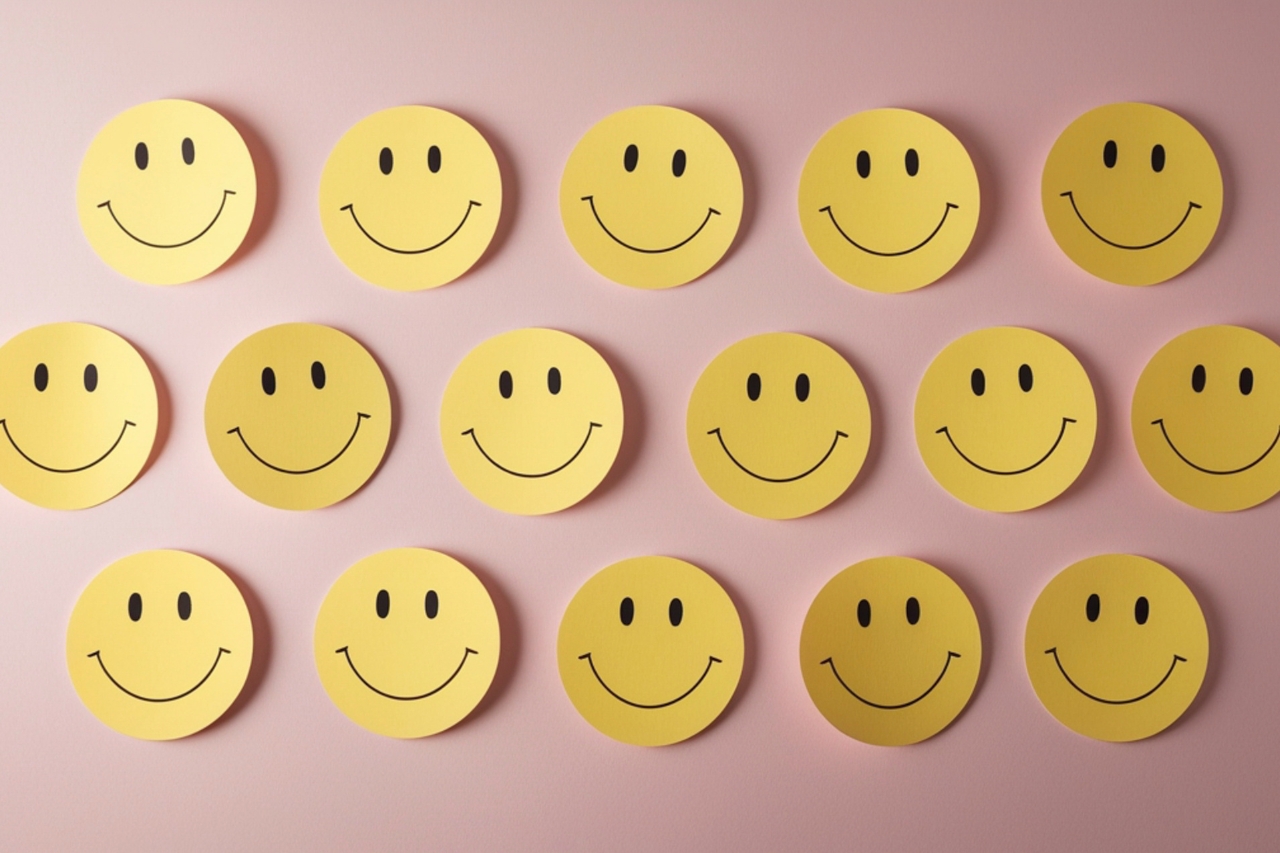
Here’s the short answer: smileys really do have a measurable effect on your brain. When you see a 🙂 your brain lights up the same face-reading machinery it uses for an actual human face. And yes, smiles — including the posed and digital kind — can nudge your mood in a genuinely positive direction. But the effects are real and modest, not magic, and in a few situations a smiley can even work against you.
That last part is what most articles on this topic leave out. So let’s go past the feel-good headline and look at what the research actually shows, because the truth is more interesting than “smileys make you happy.”
Your Brain Treats a 🙂 Like a Real Face
This is the wildest finding in the whole field, and it’s worth sitting with.
In 2014, researchers at Flinders University in Australia hooked people up to electrodes and showed them three things: real human faces, smiley emoticons like :-), and random strings of characters. They were watching for a specific brain signal called the N170 — a burst of electrical activity that fires about 170 milliseconds after you see a face, and barely reacts to anything that isn’t one.
Real faces produced a strong N170, as expected. But the standard smiley emoticon did too, as the Smithsonian reported. To the face-detecting part of your brain, 🙂 reads as a face.
Now here’s the kicker. When the researchers flipped the emoticon backwards to (-:, the brain response vanished. Same characters, same number of pixels, but in the wrong order your brain shrugs and sees punctuation.
That tells us something profound: this isn’t an instinct you were born with. Lead researcher Owen Churches pointed out that before 1982, when the emoticon was invented, there’d be no reason for 🙂 to trigger anything. Your brain learned to see a face there. It’s a brand-new neural response, built entirely by culture, in a single generation.
But It’s Not Quite the Real Thing
Before we get carried away, a dose of honesty.
Follow-up studies using the same brain-wave methods found that while emoticons and emoji do activate face-related processing, the response is generally weaker than what an actual human face produces. Your brain takes the bait, but it isn’t completely fooled. A smiley is a convincing stand-in for a face, not a perfect replacement.
That distinction matters, and it’ll come back later when we talk about why a smiley sometimes lands wrong.
Can a Smile — or a Smiley — Actually Change Your Mood?
This is where the topic gets genuinely scientifically contested, and where I’d gently roll my eyes at any article that gives you a confident one-word answer.
The idea is called the facial feedback hypothesis: the notion that your facial expressions don’t just show emotion, they can cause it. Smile, and you feel a little happier. Frown, and you feel a little worse.
For decades the poster child for this was a 1988 study where people held a pen in their teeth (forcing a smile shape) and rated cartoons as funnier. It was in every psychology textbook. Then in 2016, a massive 17-lab effort tried to reproduce it and couldn’t. The classic finding crumbled, and a lot of people wrote the whole idea off.
But that wasn’t the end of the story. In 2022, a global team called the Many Smiles Collaboration ran the most careful test yet — nearly 3,900 participants across 19 countries. Their conclusion, reported by Stanford, was that deliberately posing a smile really can make you feel happier. The effect is small, and it’s not going to cure depression, but it’s real and it held up across cultures.
Interestingly, the pen-in-mouth trick stayed unreliable. What worked was actually arranging your face into a smile on purpose, or mimicking a smiling person. The takeaway: a genuine, intentional smile carries a small mood boost. The mechanical hack doesn’t.
So where do smileys fit in? There’s a second ingredient called emotional contagion. We’re wired to mirror the expressions we see — watch someone grin and your own face subtly follows, often without you noticing. Since your brain processes a smiley partly like a face, a friendly 🙂 on your screen can trigger a faint echo of that same mirroring response. It’s a gentle nudge, not a mood-altering drug, but across a hundred little messages a day, gentle nudges add up.
Why Smileys Make Your Texts Feel Warmer
Beyond the brain wiring, smileys do practical emotional work in conversation.
Plain text is emotionally blind. It has no tone of voice, no eyebrow raise, no smile to tell you whether “okay” means “sounds great” or “I’m annoyed but dropping it.” That missing information is exactly where misunderstandings sneak in.
A smiley plugs the gap. Research on emoji and emoticons consistently shows that when the little face matches the message, it sharpens how clearly the emotional tone comes across and turns up the warmth. “Sure, I can do that :)” reads very differently from a bare “Sure, I can do that.” — and you instantly know which one you’d rather receive.
That’s the everyday superpower of the smiley. It’s not decoration. It’s the closest thing text has to a friendly tone of voice.
The Catch: When a Smiley Backfires
Here’s the part that genuinely surprised me, and the reason I won’t tell you to sprinkle smileys everywhere.
A set of studies led by Ella Glikson, summarized in a widely cited paper sometimes called “the dark side of a smiley,” found that in formal work emails, a smiley didn’t boost warmth at all — and actually made the sender seem less competent. Across hundreds of participants from dozens of countries, “in formal business emails, a smiley is not a smile.”
The reason ties back to that earlier point: a smiley is a weaker signal than a real face. In person, a smile reads as warmth and confidence. Dropped into a stiff professional email from a stranger, the same symbol can read as casual, unserious, or out of place.
But — and this is crucial — context flips the result. In informal settings, or with people who already know you, that same smiley boosts warmth with no competence penalty. The symbol didn’t change. The setting did.
So the honest rule is: a smiley amplifies friendliness when friendliness is welcome, and undercuts you when the room expects formality. Read the room first.
How to Actually Use Smileys to Lift the Mood
Putting the science together, here’s what holds up:
Use them with people you have a relationship with. That’s where smileys most reliably add warmth and where your brain’s face-response does its best work.
Match the smiley to the message. A face that fits the tone clarifies your meaning; a mismatched one just creates confusion.
Go easy in formal first impressions. New client, job application, or a serious email to someone senior? Lead with clear words, not faces, until the relationship is established.
And if you want the mood boost for yourself, the research points to the real thing over the symbol — actually smiling on purpose gives you that small, verified lift. Typing 🙂 at a friend mostly works by brightening their day, which, through the magic of a friendly reply, tends to come right back to you.
The Bottom Line
The smiley’s power isn’t a myth, but it isn’t a miracle either. Your brain genuinely treats 🙂 as a face, a learned response that didn’t even exist before the 1980s. Smiling really can lift your mood by a small, real margin. And a well-placed smiley can make a cold line of text feel human and warm.
The hidden part — the bit worth remembering — is that all of this is context-dependent. The same three keystrokes can warm up a text to a friend and chill a first impression with a stranger. Used with a little awareness, the humble smiley is one of the smallest, cheapest, and most effective emotional tools we’ve got. 🙂